

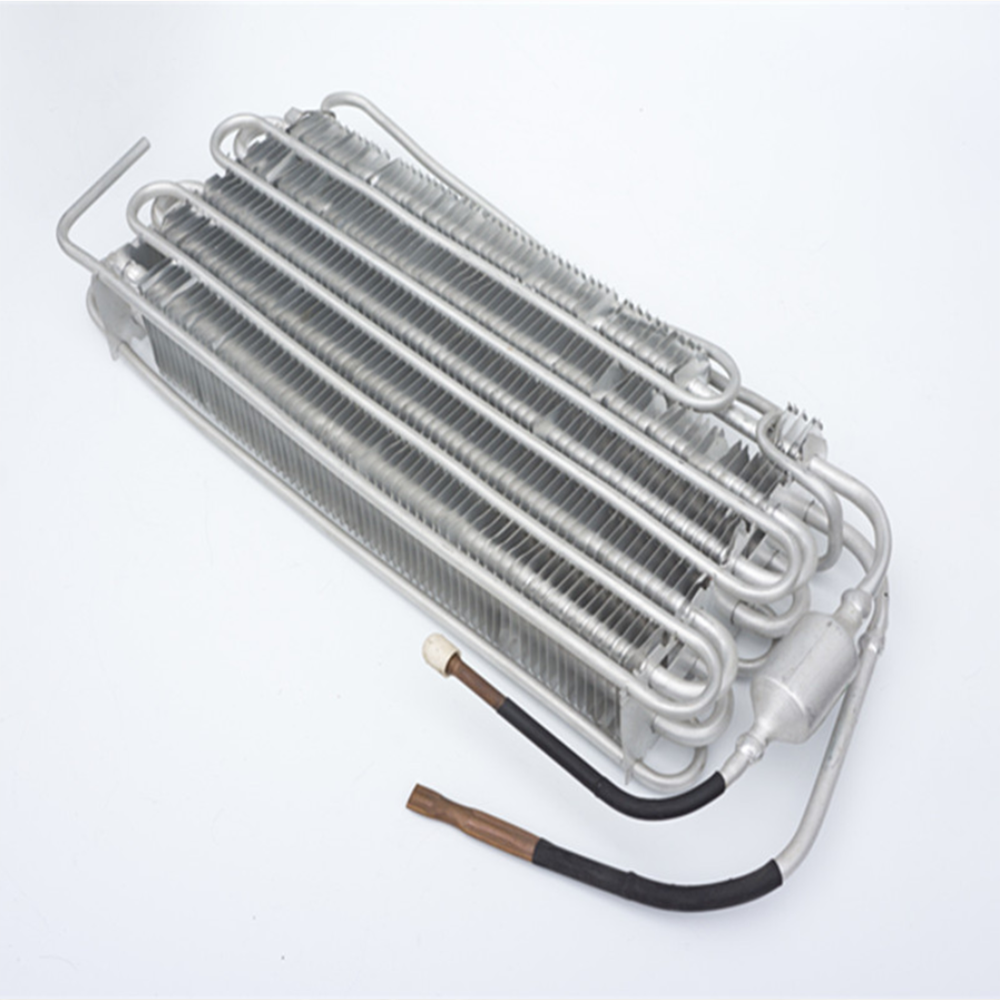
The primary role of evaporator fins is to maximize heat exchange area, enhance heat transfer efficiency, and optimize air flow to boost cooling performance. Their design directly impacts the evaporator's performance, with wide applications in refrigeration, air conditioning, and other related fields.
Core Functional Analysis
Ⅰ. Expanding Heat Exchange Area
Fins are densely arranged on the surface of evaporator tubes, significantly increasing the effective contact area with air. For example, aluminum fins typically measure 0.12–0.20 mm in thickness and 1.5–2.5 mm in pitch, a structure that can expand the heat exchange area by 5 to 10 times compared to bare tubes.
Ⅱ. Enhancing Heat Transfer Efficiency
Fins not only expand the surface area but also improve the heat transfer coefficient through the following mechanisms:
· Corrugated or slotted fin designs disrupt airflow, breaking the air boundary layer and increasing heat transfer efficiency by approximately 20% compared to flat fins.
· Materials like anodized aluminum ensure both thermal conductivity and corrosion resistance for long-term performance.
Application Scenarios and Design Variations
Fin parameters must be tailored to different scenarios:
· Air Conditioning:Narrow fin pitches (1.5–2.5 mm) prioritize high-efficiency heat exchange and low noise.
· Low-Temperature Refrigeration (e.g., cold storage):Fin pitches are increased to 8–12 mm to prevent frost blockage, and even 12–20 mm for environments below -25°C.
Structural Synergy
Fins work in tandem with other evaporator components:
· Refrigerant distributors ensure uniform coverage of liquid refrigerant across fin tubes.
· Forced convection designs (e.g., fans) coordinate with fins to optimize airflow organization, further enhancing overall efficiency.
Keywords: evaporator fins, heat exchange area, heat transfer efficiency, fin design, air conditioning, low-temperature refrigeration, forced convection, refrigerant distributor
