

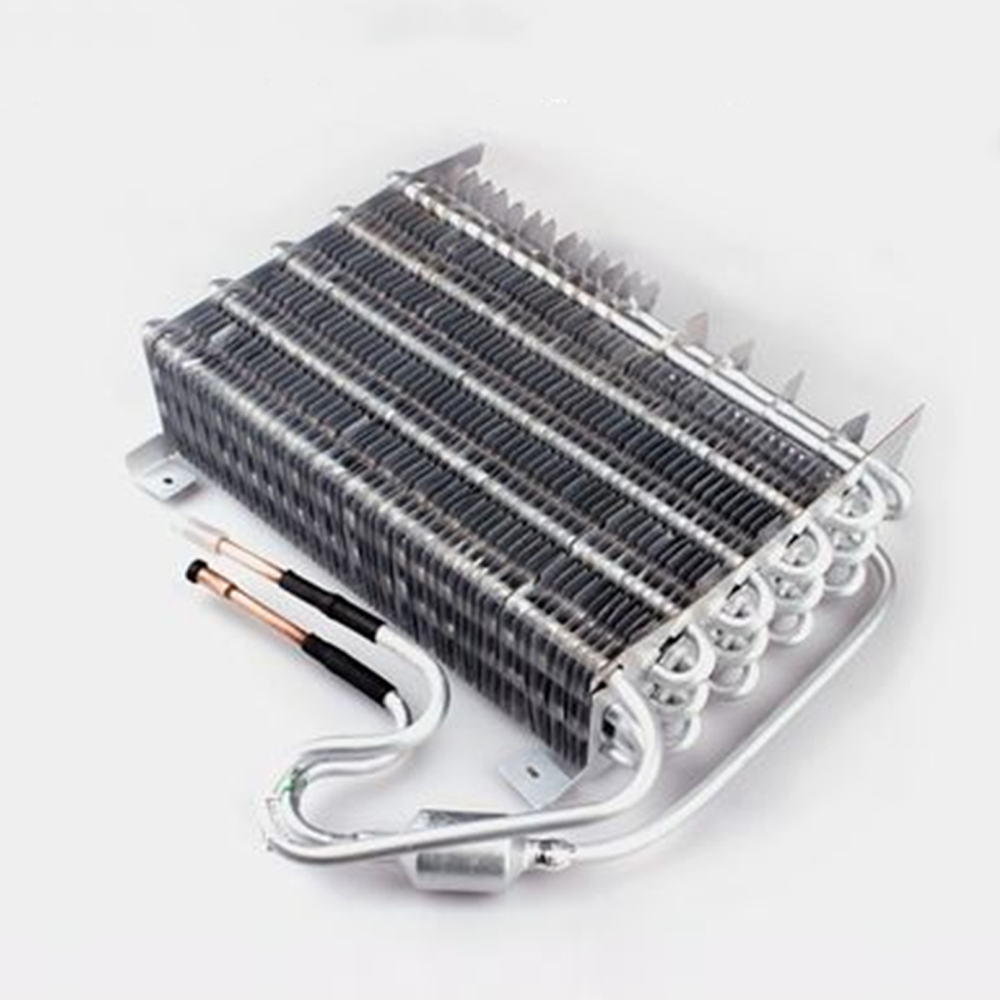
Air-cooled condensers serve as core components in refrigeration systems, primarily designed to cool and condense high-temperature, high-pressure gaseous refrigerants into liquid through air circulation, thereby releasing heat. Below is a detailed overview:
I. Structure and Working Principle
Core Components
Composed of copper tubes (with internal thread designs to enhance heat transfer), aluminum fins (such as hydrophilic aluminum foil or stainless steel for increased heat dissipation area and corrosion resistance), high-speed fans, and motors. Fins are often arranged in staggered patterns or corrugated designs to increase air turbulence and improve heat exchange efficiency.
Operation Process
High-temperature, high-pressure gaseous refrigerant discharged by the compressor enters the condenser coils. The fan drives air through the finned tubes, absorbing heat from the refrigerant. As the temperature drops, the refrigerant condenses into a liquid, flowing through the liquid outlet tube to the expansion valve to complete the heat dissipation cycle.
II. Application Scenarios
Household and Commercial Use
Widely applied in air conditioners, freezers, supermarket display cabinets, etc. For example, Haier commercial refrigeration cabinets use air-cooled condensers with dust-proof covers, suitable for food preservation scenarios.
III. Advantages and Disadvantages
Advantages
Flexible Installation: No external water source is required, making it suitable for water-scarce areas or outdoor environments.
Easy Maintenance: No complex water systems, longer cleaning cycles, and lower maintenance costs.
Safety and Reliability: Avoids scaling and corrosion issues in water-cooled systems, reducing leakage risks.
Limitations
Environment-Dependent Efficiency: Condensing pressure increases in high-temperature environments, reducing refrigeration efficiency. For example, heat exchange capacity may decline by 12% at 40°C ambient temperature.
Higher Energy Consumption: Power consumption is 30%-50% higher than water-cooled systems for the same cooling capacity.
Larger Footprint: Equipment costs are 20%-30% higher than water-cooled systems, and ample ventilation space is required.
IV. Performance Parameters and Maintenance Tips
Key Specifications
Heat Exchange Capacity: Ranges from 10kW to 500kW (standard models).
Air Volume and Pressure: Fan air volume typically ranges from 270-3,400 m³/h, air resistance 80-200Pa, and pressure test pressure 2.8MPa.
Refrigerant Compatibility: Supports various refrigerants such as R22, R134a, and R502.
Maintenance Recommendations
Regular Cleaning: Use compressed air or soft brushes to remove dust from fins monthly; inspect fan motors and circuits quarterly.
Environmental Management: Ensure no obstructions around the condenser and avoid high-temperature, high-humidity, or corrosive environments.
Fault Diagnosis: Detect refrigerant leaks (oil stains in fluorine systems) and replace aging components promptly.
V. Safety and Operation Precautions
Operation Guidelines
During system operation, ensure all valves are open (except oil discharge and air release valves), and regularly monitor condensing pressure (maximum 1.5MPa).
Turn off the fan 15 minutes after shutdown; drain water in winter to prevent freezing.
Environmental Requirements
Avoid installation in dusty areas to prevent fin blockage; keep away from fire sources and flammable materials.
Emergency Handling
Immediately shut down and inspect in case of refrigerant leaks or abnormal fan noise to avoid further damage.
Conclusion
Air-cooled condensers hold a critical position in small-to-medium refrigeration systems due to their flexible installation and low maintenance costs. Despite efficiency limitations in high temperatures, material upgrades, structural optimizations, and intelligent controls are gradually overcoming these challenges, making them a key direction in green refrigeration technology. In practical applications, weigh their advantages and disadvantages based on specific scenarios and ensure long-term stable operation through regular maintenance.
