

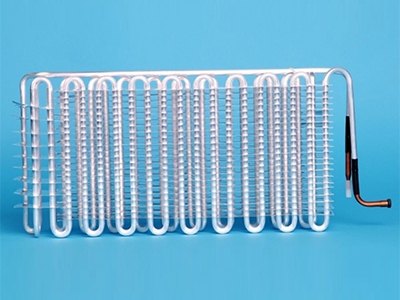
In refrigeration systems, evaporators and condensers serve as two core components, respectively responsible for "heat absorption" and "heat dissipation." The evaporator absorbs external heat through the evaporation of liquid refrigerant to achieve cooling, while the condenser releases heat through the condensation of gaseous refrigerant to complete the cycle. Take air conditioning systems as an example: the indoor evaporator cools room air, while the outdoor condenser expels heat into the atmosphere. Their collaborative operation forms a complete refrigeration cycle.
Technical Principle Distinctions:
Evaporators: Under low-pressure conditions, liquid refrigerant flowing through the evaporator coils absorbs heat and turns into gas. This process utilizes latent heat of phase change for efficient heat absorption; for instance, the evaporator in a household air conditioner can lower indoor temperatures by 5–8°C.
Condensers: High-temperature, high-pressure gaseous refrigerant exchanges heat with the external environment in the condenser. Through cooling media (such as air or water), the heat is dissipated, and the refrigerant re-condenses into a liquid. For example, the condenser in an industrial chiller can reduce water temperature from 35°C to 25°C.
II. Structural Design and Material Selection
The structural design of evaporators and condensers directly impacts their performance and energy efficiency. Evaporators typically adopt fin-tube structures to increase heat exchange area for enhanced heat absorption, while condensers often use shell-and-tube or spiral-plate designs to adapt to heat dissipation under high-pressure environments.
Material Innovations:
Evaporators: Hydrophilic aluminum fin technology reduces dew formation and boosts heat exchange efficiency.
Condensers: Corrosion-resistant coating technology, is applied in harsh environments like high-salt wastewater treatment.
III. Application Scenarios and Industry Cases
Evaporators and condensers differ significantly in application scenarios due to their functional differences. Evaporators are widely used in cold chain logistics, data centers, and other fields requiring low-temperature environments, while condensers are common in industrial cooling and energy recovery.
Typical Case Studies:
Cold Chain Logistics:
Evaporators: In cold storage facilities, air-cooled evaporators use forced convection for rapid cooling, ensuring fresh food preservation.
Condensers: Water-cooled condensers in large cold storage reduce condensation temperature through circulating cooling water, achieving a coefficient of performance (COP) exceeding 3.5.
